HACCP
Hazard analysis and critical control points across intake, processing, filling and storage.
Certificate copy available on request.

| Parameter | What it tells you | How it is measured |
|---|---|---|
| Brix | Soluble solids, i.e. how concentrated the paste is. | Refractometer |
| pH | Acidity, which matters for product safety and taste. | Calibrated pH meter |
| Colour | Redness of the paste and of your finished product. | Colorimeter |
| Bostwick | Consistency: a lower reading means a thicker paste. | Bostwick consistometer, cm/30s |
| Mould count | Raw material and process hygiene. | Howard mould count (USDA/AOAC method) |
Each batch receives its own Certificate of Analysis with the measured Brix, pH, colour, Bostwick and microbiological results. The COA is issued before the goods leave the factory and travels with the shipping documents, so your QA team can check the delivery against the numbers. A sample COA is available on request.
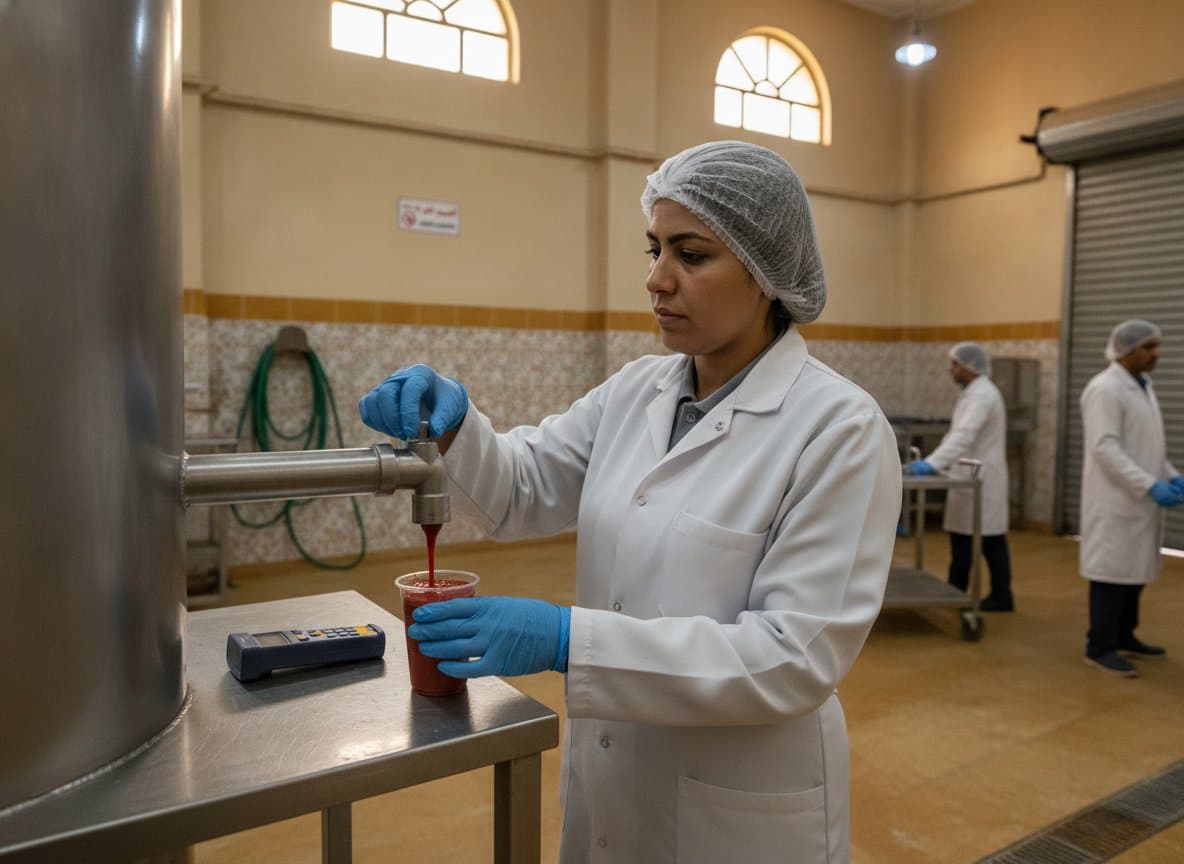
Check each value on the COA against the specification of the grade you ordered.
| Value on the COA | Grade A · 36–38% | Grade B · 28–30% | Hot Break · 28–30% |
|---|---|---|---|
| Brix | 36–38% | 28–30% | 28–30% |
| Bostwick consistency | 3.5–5.5 cm/30s | 5.0–7.0 cm/30s | 3.0–4.5 cm/30s |
| pH | 4.0–4.4 | 4.0–4.4 | 4.0–4.4 |
| Colour value | The value you chose: 1.7, 1.8, 1.9, 2.0 or 2.1 | Same | Same |
| Howard mould count | Below 30% positive fields | Below 40% positive fields | Below 40% positive fields |
Within technical limits, a target colour value or a tighter Bostwick range can be agreed for volume or private-label orders. State your targets on the quote request, and test a sample with its COA before the first order.
Hazard analysis and critical control points across intake, processing, filling and storage.
Certificate copy available on request.
Food safety management system for the full production chain.
Certificate copy available on request.
Quality management system covering process control and continual improvement.
Certificate copy available on request.
GFSI-recognised food safety certification, often required by European and multinational buyers.
Certificate copy available on request.
BRC Global Standard for Food Safety, GFSI-recognised and widely required by UK and European retailers.
Certificate copy available on request.
Halal certification for production, for buyers in the Middle East, Africa and Asia.
Certificate copy available on request.
We send a sample with its Certificate of Analysis before your first order.